Friday, February 26, 2010

"Free" Software

Today in class, we discussed the implications of using software without paying for it. This can be done by downloading it illegally, stealing registration keys, or other means. So why do people use software that they did not pay for? The main train of thought is that if I can get a software without paying for it, then why wouldn't I? Or, another popular argument is "I don't think the software is worth that much." Basically, people want a service, and since it is "available" for free, it is hard to justify spending money on it. The reason I say available in quotations is because the means for attaining such software for free is generally illegal (finding websites that cater for this are very easy to find). I think that a better question to ask is: "If the software was not available for free, would you buy it?" If the answer is yes, then that would suggest that you think the software is worth the price. If the software's services are worth the price, then why wouldn't you purchase it to support the company? Software companies make money by selling their software to the customers. If people who would've bought the software choose, rather, to illegally download it, they are losing paying customers. In order to compensate for the lost sales, the company may have to increase the price of their services in order to keep the company up and running.


While this may seem like a way that would convince people to purchase the software they enjoy using, the temptation of getting it for free is just too great. This temptation is not only limited to software, but all sorts of copyright material such as music, movies, e-books, etc. In fact, a study done in 2008 showed that 95% of music downloaded was done so illegally. And now, with the convenience and speed of Bit Torrent applications, it doesn't seem like this percentage will decrease any time soon. Is this simply a paradigm shift in the way copyright material is distributed? Or do corporations and companies simply have to do a better job of protecting their content from pirates?

Friday, February 12, 2010

Spending on the Internet

When you are young, how do you buy things that you want? In my case, I would show what I wanted to my parents, and they would decide whether they would buy it for me or not. As I grew older, my parents started giving me an allowance - they gave me cash every week and I decided how to spend it. Once I ran out of cash, I couldn't buy any more stuff and I'd have to wait until next week. But every time I bought something, I would lose cash - physically. When we are young we have a loose understanding of money, but as we grow older we develop a stronger understanding. By the time I was in highschool, I had gotten a part time job, and then money was given to me by means of direct deposit into my bank account. Now, the money started to become a bit more complex of a concept. I never actually saw the money I made, only a pay stub with the amount I made written on it, and a bank account balance that showed my income. So now, rather than being limited by the amount of cash I carried, I was limited by the number that appeared on my bank account balance. When I turned 18, I got a credit card... At this point, my bank account's balance was no longer the limiting factor in how much I could spend, but rather my monthly credit limit. But still, every purchase I made, I read a price tag and scanned the item at the cashier's till - I could still conceptualize the loss of money for every purchase I made.


But now, most of my credit card transactions occur on online stores and listings websites. No longer are there price tags, and an exchange of cash - only numbers. I see the price - just a number underneath the product. I pay for it, I just enter my credit card number. The charge appears on my monthly bill. All numbers. It honestly feels like I am not spending money, but the reality is that I am spending much more money than I would have if I were buying these products in real life. When I buy a candy at the convenience store, I give the cashier my $5 bill, and I get the candy and some change back. I can see the transaction, and everything is very clear. But when shopping online, the way money is spent is more abstract, and so you lose the sense of spending actual money.

Friday, February 5, 2010

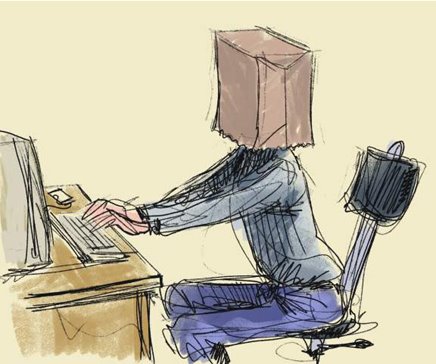
Larry, on the internet

Earlier in the week we spoke of anonymity on the internet, and also what happens when you search your own name on a search engine. When you want to find information about something or somebody, the first thing people would do nowadays would be to "google" it or "wiki" it. That is, search for the information online through Google's search engine, or to search the information on WikiPedia's online database. While this may be a good way to find websites containing information on relatively well-known people or information, we see that there is information which repeats the exact same information. For example, I was looking for details regarding a specific t-shirt released in 2007, I read the exact same articles on Freshness, Format, and Hypebeast, none of which contained the information I was looking for. But when I searched my own name on Google, no results pertaining to myself appeared (although I only looked through the first 10-15 search results pages). So why is it that there is so much duplicity of relatively well known information, but no information on someone or something that is less recognized world wide?


You may think that because there are no search results for somebody's name that perhaps they just do not use internet services as much as, say, somebody who writes a blog. However, I have alot of online activity, and I have several accounts on many websites and I also contribute to blogs, but still there are no search results on me. The reason why is because I almost all of my online activity is done anonymously. None of my accounts online are associated with "Larry Yang" (except those that involve credit cards i.e. PayPal). I often buy/sell/trade various things online between people I have never met before, and most of the time I will never even find out their name, and vice versa. So I actually have alot of websites and activity on several chat boards, but nobody would ever know by googling my name. So while I am doing things anonymously, I am doing no harm to people and the reason I choose anonymity is for security, but there are many people who abuse anonymity on the internet. For example, on many message boards, there are users who spam offensive material, and thus their accounts are closed. However, there is no way to prevent those same people to create a new account, and this scenario is very common.