So, things such as computer models which are currently used to predict trends such as stock market prices, weather forecasts, earth plate shifts, these are all made possible by such technological advances previously mentioned. While they are not completely accurate, we have no right to complain about their efficacy, because the mere fact that they exist is a blessing, and by depending on these services 100% just shows our own dependence on technology.
Tuesday, April 6, 2010
How reliable are computer models?
We live in a time with so much technological services to our expense that we don't know what to do with it all. There are new advances in technology every day, and I think that we have gotten to the point that we take it for granted. Even computers themselves are completely amazing. We have a little box that can do so many things that would be unimaginable otherwise. The fact that the internet exists is extraordinary - we can communicate in a many to many fashion, and there is a link between people all over the world! But still, we complain that our internet is too slow, the video quality is too poor, and all sorts of other things that we would not be even within the realm of possibility a few years previous. I think comedian Louis C.K. sums it up pretty well in the viral YouTube clip:
So, things such as computer models which are currently used to predict trends such as stock market prices, weather forecasts, earth plate shifts, these are all made possible by such technological advances previously mentioned. While they are not completely accurate, we have no right to complain about their efficacy, because the mere fact that they exist is a blessing, and by depending on these services 100% just shows our own dependence on technology.
We should learn to appreciate these services and understand their limitations, rather then become angered that they are not "good enough." We must consider the fact that these computer models are able to predict certain trends to a certain precision and realize that even if they are not perfect, they are better then nothing - which is what we had before!
So, things such as computer models which are currently used to predict trends such as stock market prices, weather forecasts, earth plate shifts, these are all made possible by such technological advances previously mentioned. While they are not completely accurate, we have no right to complain about their efficacy, because the mere fact that they exist is a blessing, and by depending on these services 100% just shows our own dependence on technology.
Thursday, April 1, 2010
Violence in Video Games?
A topic that is often discussed in this class is the "side effects" of new technology. While our technologies are developed to serve a purpose, there are often other ramifications that were not previously anticipated. Video games were created for entertainment purposes. While they were originally oriented towards children, now a days video games serve many purposes and are catered to all groups of people. There are learning games for children, there are simulation games for professional trainees, and of course, there are multiple genres for entertainment purposes. However, within each of these categories there are games which are oriented to different demographics. For example, within educational games, there may be games to help children learn how to count, but for older people there are also games to aid in learning a new language, and at high levels of learning, there are games made to simulate real life experiences such as flight simulation.

A topic that was raised during class was that children are playing violent video games, such as Grand Theft Auto, and are being influenced by these video games to behave belligerent. Also, the fact that video game graphics are becoming more realistic and graphic may be serving to desensitize children to such violence. However, are these concerns warranted? While these video games DO portray violence and the graphics are more and more realistic, we must realize who these games are catered to. The game makers label their games as violent, or graphic, or "Mature Content" because these games are not made for children. Children are easily impressioned, and may indeed be influenced by the depiction of violence, however in healthy adults, by playing video games with such content may serve as a safe outlet of such behaviour and rather then being influenced by it, they are getting rid of their violent tendencies through an electronic game. The fact that children are playing these games do no show flaws in the games themselves, but rather the distribution of the games. We need to have safer ways of selling videogames, and denying access to children under the age of 18 to access these games. The law is not very firm in these respects, and if it is such a concern to the general public, then we need to make these changes rather then changing the content of videogames themselves.
Friday, March 19, 2010
Difficulties finding a job in CS?
The last few days in class, we have discussed the difficulties in finding jobs in computer science nowadays, and how IT personnel are low in demand. Many people found that after investing both time and money into an education in computer science, they were left working low paying, entry level jobs because the quota for more profitable positions were already filled. This may be caused by many factors such as: The recession, the outsourcing of IT positions, and possibly a burst of the IT bubble. Whatever the reasons, this job shortage is affecting everybody studying computer science. However, as a computer science student, so far I have not have any trouble finding any relevant and well paying jobs. Even though I am merely a student, I have been offered IT jobs, entry level programming jobs, and even research opportunities. Based on this, I personally do not feel the effects of the low amount of IT jobs being offered. I realize that the jobs which I have considered were all student jobs or entry level jobs, and that these are not the jobs which are being sought after by most graduates. And also, the selection process of candidates of these jobs are often based on academics, and this may be a problem for some.
However, perhaps the problem is that the upper level jobs are actually being taken by those working the entry-level jobs, by promotion. So perhaps the way that people can get these jobs is by applying for the entry-level jobs as students, and continue to work towards higher positions in the job.
Wednesday, March 10, 2010
Scammers
Internet scamming has been around ever since the time that online transactions were made possible. As discussed in class, many internet crimes are the same general idea as their real-life counterparts. For example, many scammers go door-to-door and solicit for, say, a charity, and take the money for themselves. Online, there are these types of scams all the time. Online theft is not as common, but it can still happen. This is usually done through either identity theft or hacking. Stealing from an online store can be tricky, but it is definitely common enough that online stores take many precautions. For example, an online store that I recently ordered shoes off of required that I pay extra shipping insurance, provide credit card information AND both a scanned version of my credit card and a photo identification card. These are extreme security measures which are implemented in order to discourage the practice of identity theft, and also to ensure the user of the credit card is indeed the one who is purchasing the items. These security measures are a big hassle, and prolong the transaction process by a long time: the communication between buyer and seller is done through e-mails, and the store rarely replies e-mails within the same day. Such measures are put in place because the store has been scammed by a customer before, and thus to prevent it from happening again, the buyer must perform these actions in order to buy the shoes he wants.
As we see in the example of this online store, the ones who suffer from the acts of scammers are not only the seller who lost their products without proper payment, but also those who want to buy from this store in the future! The store is now aware that scammers are rampant in the online community, and is cautious of all online buyers. The online stores are now skeptical of who is a scammer and who is not. The result, for us non-scammers, is that transactions are delayed, we must make extra efforts to prove that we are not scamming, and the price of products and services must be increased in order to balance the money lost through scams.
Friday, February 26, 2010
"Free" Software
Today in class, we discussed the implications of using software without paying for it. This can be done by downloading it illegally, stealing registration keys, or other means. So why do people use software that they did not pay for? The main train of thought is that if I can get a software without paying for it, then why wouldn't I? Or, another popular argument is "I don't think the software is worth that much." Basically, people want a service, and since it is "available" for free, it is hard to justify spending money on it. The reason I say available in quotations is because the means for attaining such software for free is generally illegal (finding websites that cater for this are very easy to find). I think that a better question to ask is: "If the software was not available for free, would you buy it?" If the answer is yes, then that would suggest that you think the software is worth the price. If the software's services are worth the price, then why wouldn't you purchase it to support the company? Software companies make money by selling their software to the customers. If people who would've bought the software choose, rather, to illegally download it, they are losing paying customers. In order to compensate for the lost sales, the company may have to increase the price of their services in order to keep the company up and running.

While this may seem like a way that would convince people to purchase the software they enjoy using, the temptation of getting it for free is just too great. This temptation is not only limited to software, but all sorts of copyright material such as music, movies, e-books, etc. In fact, a study done in 2008 showed that 95% of music downloaded was done so illegally. And now, with the convenience and speed of Bit Torrent applications, it doesn't seem like this percentage will decrease any time soon. Is this simply a paradigm shift in the way copyright material is distributed? Or do corporations and companies simply have to do a better job of protecting their content from pirates?
Friday, February 12, 2010
Spending on the Internet
When you are young, how do you buy things that you want? In my case, I would show what I wanted to my parents, and they would decide whether they would buy it for me or not. As I grew older, my parents started giving me an allowance - they gave me cash every week and I decided how to spend it. Once I ran out of cash, I couldn't buy any more stuff and I'd have to wait until next week. But every time I bought something, I would lose cash - physically. When we are young we have a loose understanding of money, but as we grow older we develop a stronger understanding. By the time I was in highschool, I had gotten a part time job, and then money was given to me by means of direct deposit into my bank account. Now, the money started to become a bit more complex of a concept. I never actually saw the money I made, only a pay stub with the amount I made written on it, and a bank account balance that showed my income. So now, rather than being limited by the amount of cash I carried, I was limited by the number that appeared on my bank account balance. When I turned 18, I got a credit card... At this point, my bank account's balance was no longer the limiting factor in how much I could spend, but rather my monthly credit limit. But still, every purchase I made, I read a price tag and scanned the item at the cashier's till - I could still conceptualize the loss of money for every purchase I made.

But now, most of my credit card transactions occur on online stores and listings websites. No longer are there price tags, and an exchange of cash - only numbers. I see the price - just a number underneath the product. I pay for it, I just enter my credit card number. The charge appears on my monthly bill. All numbers. It honestly feels like I am not spending money, but the reality is that I am spending much more money than I would have if I were buying these products in real life. When I buy a candy at the convenience store, I give the cashier my $5 bill, and I get the candy and some change back. I can see the transaction, and everything is very clear. But when shopping online, the way money is spent is more abstract, and so you lose the sense of spending actual money.
Friday, February 5, 2010
Larry, on the internet
Earlier in the week we spoke of anonymity on the internet, and also what happens when you search your own name on a search engine. When you want to find information about something or somebody, the first thing people would do nowadays would be to "google" it or "wiki" it. That is, search for the information online through Google's search engine, or to search the information on WikiPedia's online database. While this may be a good way to find websites containing information on relatively well-known people or information, we see that there is information which repeats the exact same information. For example, I was looking for details regarding a specific t-shirt released in 2007, I read the exact same articles on Freshness, Format, and Hypebeast, none of which contained the information I was looking for. But when I searched my own name on Google, no results pertaining to myself appeared (although I only looked through the first 10-15 search results pages). So why is it that there is so much duplicity of relatively well known information, but no information on someone or something that is less recognized world wide?

You may think that because there are no search results for somebody's name that perhaps they just do not use internet services as much as, say, somebody who writes a blog. However, I have alot of online activity, and I have several accounts on many websites and I also contribute to blogs, but still there are no search results on me. The reason why is because I almost all of my online activity is done anonymously. None of my accounts online are associated with "Larry Yang" (except those that involve credit cards i.e. PayPal). I often buy/sell/trade various things online between people I have never met before, and most of the time I will never even find out their name, and vice versa. So I actually have alot of websites and activity on several chat boards, but nobody would ever know by googling my name. So while I am doing things anonymously, I am doing no harm to people and the reason I choose anonymity is for security, but there are many people who abuse anonymity on the internet. For example, on many message boards, there are users who spam offensive material, and thus their accounts are closed. However, there is no way to prevent those same people to create a new account, and this scenario is very common.
Friday, January 29, 2010
iPad
A recent discussion topic is the announcement of Apple's newest product, the iPad. When I first heard that Apple was developing a tablet style touch screen computer, I was filled with excitement. I have used several tablet computers in the past and have been very pleased, and with Apple's ingenuity and reputation for sleek designs, I was looking forward to seeing how they proceed with this. When Apple finally revealed the product, I was very, very disappointed. From what has been seen thus far, this "tablet" did not live up to my expectations at all, and I think many others feel the same way. This tablet is no more of a computer than my iPhone. In fact, my iPhone can basically do everything most iPads will be able to do, such as make phone calls, send SMS, and use wireless 3G network for internet. You could think of the iPad as an oversized ipod touch, really:
The iPad runs the same operating system as iPhones and iPod touches, so that really limits it's capabilities as a computer. That means the applications you run on your Apple computer will not run on your iPad. Another thing is the lack of flash compatibility for Safari on the iPad, which really limits the browsing capabilities of the device. In fact, the benefits of portability are essentially negated by it's limitations of browsing and application use. It has no keyboard or mouse, so you have to be touching the screen for most interactions - so if you have the tablet on your lap, you will have to look down the entire duration of your use in order to view the screen. Furthermore, the iPad does not even contain a hard drive, so the storage space is very poor. My iPhone has the same amount of storage space as the entry level iPad, and my phone is only a quarter the size! And not to mention the name of the product always provokes a few chuckles. Unless they revamp this product after hearing all of the negative feedback, I think I'll stick with my iPad mini:
Another topic we discussed in class was the idea of being hardwired to print. Computers have not been used by the general population for too long of a time. Most adults are used to pen and paper, or at least printing off the documents which were created on the computer. I think that over time, the use of computer will become the absolute standard (as pen and paper was/is) and that everything will move towards being electronic - which is something we are already beginning to see. This semester at the University of Regina, 4 out of 5 of my classes have content on URCourses, and in all of those classes, assignments are distributed and submitted electronically via the URCourses system. Now, I don't need to print off a copy of my assignment to hand in, because it all exists electronically. This is much more convenient, and it is physically easier to organize, because I can misplace an assignment, but data can be searched on the hard drive of my computer. For some important documents, such as transcripts, important emails, I like to print off a copy in order to have both physical and electronic copies in case one or the other is lost or damaged. The beauty of electronic storage is that an electronic document that is on my computer can easily be uploaded to a server or storage service on the internet, and then can be accessed and downloaded anywhere I go. This may be the ultimate way to avoid losing an important document.
Friday, January 22, 2010
Google - Now Serving Cowardliness?
In class the other day, we were talking about Google censorship in China, and the implications of that. While it was believed that this censorship was limited to foreign countries, it was found that Google filters the suggestions that are shown when you type in a query. Immediately, I remembered a "motivational poster" that I saw a few weeks earlier:
Sure enough, this controversy was brought up and discussed in class. Google started out as a small search engine boasting that it had the best searching algorithm to find the most relevant web pages related to your search. However, as the search engine became more popular, Google has become a massive conglomerate of multiple services, such as online maps (Google Maps), advertisement (Google AdSense), and even internet browsing itself (Google Chrome). Google offers services and conveniences that have infiltrated our lives, and Google definitely has a significant impact on people all over the world.
So for Google to show search suggestions for "[____ religion] is", but not showing suggestions for "Islam is", is a huge controversy for many people. But is it really that controversial? Google clearly states in their help page that they "try to filter out suggestions that include pornographic terms, dirty words, and hate and violence terms." I think it is very possible that the most popular search results for "Islam is . . ." contain hate or violent terms. Remember that when you search for "Islam is . . .", there are results; there just aren't any suggestions. So while many people are saying that Google is censoring out Islam searches, they are just censoring the suggestions - not the results (or are they?). When people start typing their searches, by default the suggestions automatically appear below, it would be inappropriate to show a series of offensive phrases just because they were popular queries.
Also, we mentioned in class the fact that people accept EULAs for various software without even reading what it is they are agreeing to. Well, somebody took the time to read the EULA for iTunes and Quicktime, and there was an interesting clause in section 8:
How one could use iTunes to produce biological weapons is beyond me, but the fact that they include this in the EULA may imply that in fact there is a way. I am not suggesting that we go and try, but I thought that this clause in the EULA was very funny, and probably goes unnoticed to most people who have installed the programs (me included).
So for Google to show search suggestions for "[____ religion] is", but not showing suggestions for "Islam is", is a huge controversy for many people. But is it really that controversial? Google clearly states in their help page that they "try to filter out suggestions that include pornographic terms, dirty words, and hate and violence terms." I think it is very possible that the most popular search results for "Islam is . . ." contain hate or violent terms. Remember that when you search for "Islam is . . .", there are results; there just aren't any suggestions. So while many people are saying that Google is censoring out Islam searches, they are just censoring the suggestions - not the results (or are they?). When people start typing their searches, by default the suggestions automatically appear below, it would be inappropriate to show a series of offensive phrases just because they were popular queries.
Also, we mentioned in class the fact that people accept EULAs for various software without even reading what it is they are agreeing to. Well, somebody took the time to read the EULA for iTunes and Quicktime, and there was an interesting clause in section 8:
Friday, January 15, 2010
Social Networking
I was not registered for CS 280 until today, but I feel like web 2.0 has been an important topic thus far in the course. Web 2.0 is about everybody being able to contribute, whether constructively or destructively, to the pool of information on the internet. But it also goes beyond that, by giving people a way to link together and communicate.
There are a lot of popular websites now, and now most websites can be considered "web 2.0", or at least have some capability for users to add something. Here is a funny cartoon photo depicting the personifactions of a few websites:

When I first saw this photo, I thought the difference in depiction of Facebook and MySpace was funny, since I have used both websites. The depiction was funny to me because I used MySpace when I was younger, and Facebook now, and the cartoon basically shows the difference between the two sites. Facebook looks more mature, but still young, probably a college student. Myspace looks like a self-centred, obnoxious, teenager, and always has music on.
Both sites are social networking websites, and there are many similar sites on the web as well. So how do we choose which one to use? And why do we switch from one site to another?
The internet is young, and it is constantly changing. Maybe we switch websites because the newer ones are simply just better, or more fitting for what we need them for. I like Facebook alot better then MySpace simply because every MySpace page is completely cluttered and obnoxiously filled with sparkling animations in the background. Not to mention the music which automatically plays every time I click on a page, and half the time I can't find the music player to turn the noise off!
Facebook has a lot more tools that are useful for social networking, and features that people actually use. Such as the Events application. Now, instead of having to text message your whole phone book to tell them the plans, you can create that event on Facebook, and with a few clicks everybody will know the details and can R.S.V.P. just as easily. Ever since Facebook has gained popularity, it's features are becoming more and more embeded into the rest of our technology. Such as the Mobile Uploads feature, which allows us to take photo's with our camera-phones and add those photo's to our Facebook page without using a computer. How awesome is that!
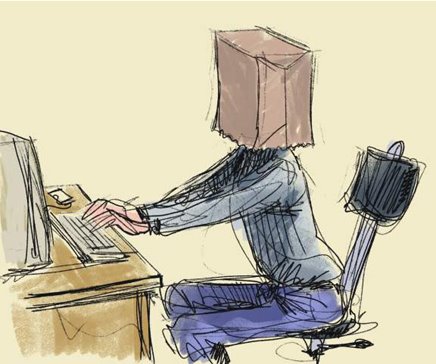
While websites such as Facebook and MySpace are sites where your identity is made public and is mainly used to connect with friends or people you already know, there are many websites which provide a way for people to communicate anonymously with people who have similar interests. There are many discussion boards like these that I frequent, such as Sherdog, which is a board where users discuss the sport of professional Mixed Martial Arts. This was the first discussion board that I have joined, and I have joined many more since then. It is always interesting to see what people say or how they act when they can do things anonymously. Having the invisible shield of the internet protecting you from any physical harm can turn even the biggest wimp into an internet tough guy. On the other hand, anonymity can allow people to remove the filter from their thoughts and basically let out whatever is going on in their mind. Some of the funniest things I've read were in user comments on the YouTube videos that I've seen.
Well, that is it for the first blog post. The next post should be more relevant to class material, since I will have actually attended the lectures!
There are a lot of popular websites now, and now most websites can be considered "web 2.0", or at least have some capability for users to add something. Here is a funny cartoon photo depicting the personifactions of a few websites:
When I first saw this photo, I thought the difference in depiction of Facebook and MySpace was funny, since I have used both websites. The depiction was funny to me because I used MySpace when I was younger, and Facebook now, and the cartoon basically shows the difference between the two sites. Facebook looks more mature, but still young, probably a college student. Myspace looks like a self-centred, obnoxious, teenager, and always has music on.
Both sites are social networking websites, and there are many similar sites on the web as well. So how do we choose which one to use? And why do we switch from one site to another?
The internet is young, and it is constantly changing. Maybe we switch websites because the newer ones are simply just better, or more fitting for what we need them for. I like Facebook alot better then MySpace simply because every MySpace page is completely cluttered and obnoxiously filled with sparkling animations in the background. Not to mention the music which automatically plays every time I click on a page, and half the time I can't find the music player to turn the noise off!
Facebook has a lot more tools that are useful for social networking, and features that people actually use. Such as the Events application. Now, instead of having to text message your whole phone book to tell them the plans, you can create that event on Facebook, and with a few clicks everybody will know the details and can R.S.V.P. just as easily. Ever since Facebook has gained popularity, it's features are becoming more and more embeded into the rest of our technology. Such as the Mobile Uploads feature, which allows us to take photo's with our camera-phones and add those photo's to our Facebook page without using a computer. How awesome is that!
While websites such as Facebook and MySpace are sites where your identity is made public and is mainly used to connect with friends or people you already know, there are many websites which provide a way for people to communicate anonymously with people who have similar interests. There are many discussion boards like these that I frequent, such as Sherdog, which is a board where users discuss the sport of professional Mixed Martial Arts. This was the first discussion board that I have joined, and I have joined many more since then. It is always interesting to see what people say or how they act when they can do things anonymously. Having the invisible shield of the internet protecting you from any physical harm can turn even the biggest wimp into an internet tough guy. On the other hand, anonymity can allow people to remove the filter from their thoughts and basically let out whatever is going on in their mind. Some of the funniest things I've read were in user comments on the YouTube videos that I've seen.
Well, that is it for the first blog post. The next post should be more relevant to class material, since I will have actually attended the lectures!
Subscribe to:
Posts (Atom)